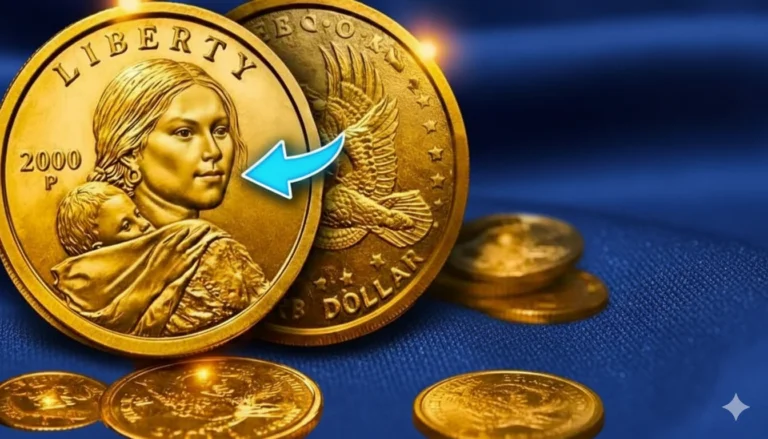
Sacagawea Dollar Value Explained : Most people see dollar coins as ordinary pocket change, but in the world of coin collecting, small details can turn everyday currency into a priceless treasure. One remarkable example involves a rare version of the Sacagawea Dollar that collectors believe could be worth up to $2.5 million due to an extraordinary minting error and historical uniqueness.
This golden-colored coin, first introduced in 2000, honors the Native American guide Sacagawea who helped lead the Lewis and Clark expedition across North America. While millions were produced, a tiny number were struck differently — and those are the coins collectors dream about finding.
Why the Sacagawea Dollar Is Special
When the U.S. Mint released the coin at the start of the new millennium, it aimed to replace the paper dollar in circulation. The coin featured a manganese-brass outer layer giving it a gold appearance, making it instantly recognizable.
Most examples are only worth face value. However, a handful of early production pieces were accidentally struck using experimental dies meant for a different coin design. These unusual strikes created a rare variety known among collectors as a “mule” error — a coin made using mismatched front and back designs.
Because so few exist, demand skyrocketed the moment collectors confirmed the mistake.

The Famous Mule Error
The rare version combines the front of the Sacagawea Dollar with the reverse design of a Washington quarter. This mismatch should never have happened during minting, which makes the coin incredibly valuable.
Collectors value it for three main reasons:
Unintentional production mistake
A mechanical or procedural error at the mint created a unique combination.
Extremely low population
Only a very small number are known to exist.

Historical curiosity
It represents one of the most famous modern mint errors in U.S. coinage.
In top condition, auction estimates have pushed values toward multi-million-dollar territory.
How to Identify a Rare Sacagawea Dollar
You don’t need expensive equipment to begin checking — just careful observation.
Look for:
-
A quarter-style eagle reverse instead of the normal soaring eagle
-
Sharper proof-like surfaces
-
Unusual strike quality
-
Heavier appearance than regular coins

If noteable differences appear, a professional grading service should verify authenticity immediately.
Coin Specifications
| Feature | Details |
|---|---|
| First Year | 2000 |
| Composition | Manganese-Brass Alloy |
| Normal Value | $1 Face Value |
| Rare Variety | Mule Error Strike |
| Estimated Top Value | Up to $2.5 Million |
| Historical Theme | Lewis & Clark Expedition |
Why Condition Matters
Even a rare coin’s value depends heavily on preservation. Scratches, cleaning marks, or wear can dramatically reduce worth. Collectors use professional grading scales, and a near-perfect grade can multiply the price many times over.
This is why discovered coins should never be cleaned — cleaning often reduces collector value instead of improving it.
Could You Really Find One?
Yes — though the odds are extremely small. Some valuable coins have been found in bank rolls and old coin jars because people didn’t realize their importance. Since the Sacagawea Dollar circulated widely in the early 2000s, a rare example could still exist unnoticed in a collection.

1. Are all Sacagawea Dollars valuable?
No, most are worth only $1 unless they have rare mint errors.
2. What makes the rare one worth millions?
A unique mule error combining two different coin designs.
3. Should I clean an old coin before selling?
No, cleaning usually reduces its collector value.
4. Where can I verify authenticity?
Professional coin grading and authentication services.